Showing posts with label inpainting. Show all posts

Tuesday, July 19, 2011

Discovering Secrets of Revealing Inpainting (Retouchings) on Art and Antiques with a UV Black light - TIPS!

Here’s a very useful tip for art collectors who use a black light. Using a blacklight is part of your investing survival techniques and technology! Everyone should use a black light when inspecting and evaluating art and antiques.
This painting is leaving the lab today, after we repaired a rip in the center of the painting. It poses an interesting uv light inspection problem though… its a night scene.
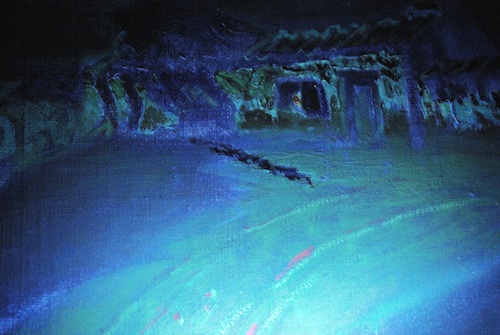
Retouching shoing up with a blacklight
New inpainting/retouchings show up bright with a UV black light


As you can see in the photo, even though its been cleaned, it still glows green. That’s because night scenes have lots of varnish usually in the paint. So, if you see a night scene glowing green when you shine your black light on it, it MAY not be because of old varnish!
One good thing about this though; the green glow makes it easier to pick out inpainting or retouchings. And this photo is a great example:
Note the purple nature of the composition of the painting. How do you tell the difference between a purple glowing original detail and the same purpleness of a retouching? Look to see if the purple color pattern follows the painting’s compositional details. If it cuts through details of the painting, its surely a repair… as in this painting.
Also note the careful exact way this inpainting was done. It was done with a small brush. That’s a hint that the conservation work/restoration work was conscientiously done.
Was this article helpful or interesting? Leave a comment please.
For more info on black lights, tips and fun videos, go to www.tipsforartcollectors.org/blacklight-package
Conservation questions? Call Scott at 805 564 3438
Appraisal questions? Call Richard at 805 895 5121
See YouTube Channel “bestartdoc”

Monday, October 4, 2010

Art Salvage of Giverney Painting - Monet's Colony

I was called by an 80ish year old lady who had inherited a closet full of paintings, all by the same artist V. Radimsky, that her Dad had bought in Paris in 1922. They had never been shown or put up on the walls. They were all on stretcher bars except one that was rolled up like a newspaper and was considered destroyed.

Since, as a professional art conservator, our ethics don't let us get into buying and selling, I was kind of caught in the middle of helping the owner connect with a buyer who bought the whole collection, even though the artist is pretty well unknown. As a thank you, the owner gave me the destroyed, rolled up painting.


The painting was dirty, paint was flaking off, deep cracking patterns distorted the whole surface...not a pretty sight. So, started by carefully consolidating the flaking by absorbing thermoplastic adhesives into the cracks. They we relaxed the cracks and distortions on the hot table and lined the picture. Once lined and stable, we were able to clean it which brought out the original colors, restored depth of field and contrast to the composition. Then we filled the paint losses, carefully and accurately inpainted and then varnish. It was put onto new stretcher bars and... voila'. Ready to go for another 100 years. Was it worth the effort. You decide.


A little about Radimsky: he went to France to be part of the painting experience surrounding Monet's colony. We assumed this painting was of Giverney as others in the collection that looked similar in technique and subject had written on the stretcher bars by the artist "Giverney." Radimski was hit and killed by a car I believe in 1921.