Tuesday, July 26, 2011

How much does it cost to clean a painting? See video


I'm asked this question all the time over the phone. Sight unseen, there is supposed to be, I assume, a standard, per sq. inch price! Sorry... it's much more complicated than that.

Here's an interesting video of a cleaning we did of two important pictures that were by the same artist, same size but very different to clean. Take a look: http://bit.ly/qGRQsW 

Cleaning a painting by Armin Hansen from the Monterey Museum of Art
Art conservation/restoration questions? Call Scott Haskins at 805 564 3438
Art appraisal questions? Call Richard at 805 895 5121
See our YouTube Channel at "bestartdoc"

Leave a comment!

Tuesday, July 19, 2011

Discovering Secrets of Revealing Inpainting (Retouchings) on Art and Antiques with a UV Black light - TIPS!

Here’s a very useful tip for art collectors who use a black light. Using a blacklight is part of your investing survival techniques and technology! Everyone should use a black light when inspecting and evaluating art and antiques.
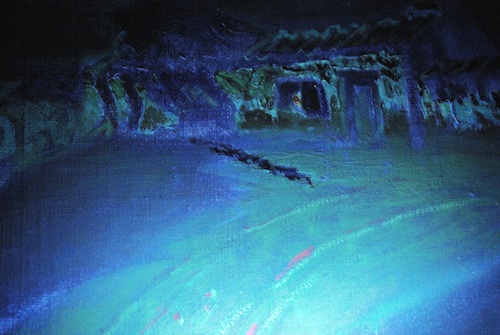
This painting is leaving the lab today, after we repaired a rip in the center of the painting. It poses an interesting uv light inspection problem though… its a night scene.

Retouching shoing up with a blacklight
New inpainting/retouchings show up bright with a UV black light


As you can see in the photo, even though its been cleaned, it still glows green. That’s because night scenes have lots of varnish usually in the paint. So, if you see a night scene glowing green when you shine your black light on it, it MAY not be because of old varnish!
One good thing about this though; the green glow makes it easier to pick out inpainting or retouchings. And this photo is a great example:
Note the purple nature of the composition of the painting. How do you tell the difference between a purple glowing original detail and the same purpleness of a retouching? Look to see if the purple color pattern follows the painting’s compositional details. If it cuts through details of the painting, its surely a repair… as in this painting.
Also note the careful exact way this inpainting was done. It was done with a small brush. That’s a hint that the conservation work/restoration work was conscientiously done.
Was this article helpful or interesting? Leave a comment please.
For more info on black lights, tips and fun videos, go to www.tipsforartcollectors.org/blacklight-package
Conservation questions? Call Scott at 805 564 3438
Appraisal questions? Call Richard at 805 895 5121
See YouTube Channel “bestartdoc”

Saturday, July 16, 2011

Sneak Peak In The Art Conservation Lab This Week

Art conservation treatments this week in the lab show handling large paintings and working on the hot table.
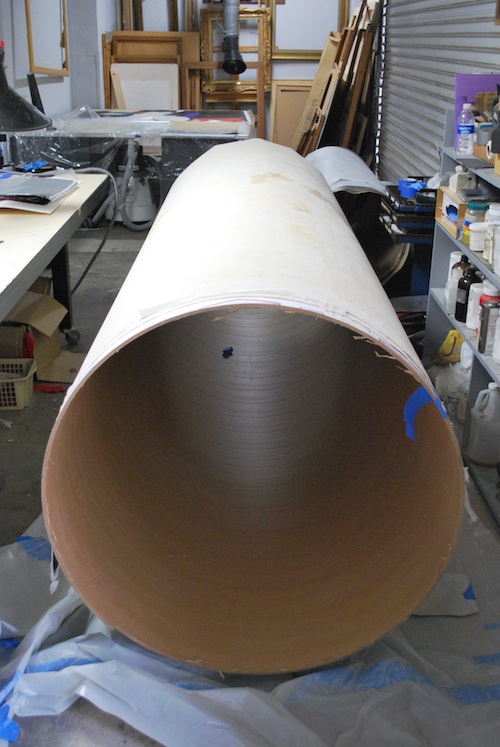
Large paintings need special handling to make sure the paint is not stressed (this is a 3' diameter tube):
Large paintings on large diameter rolls
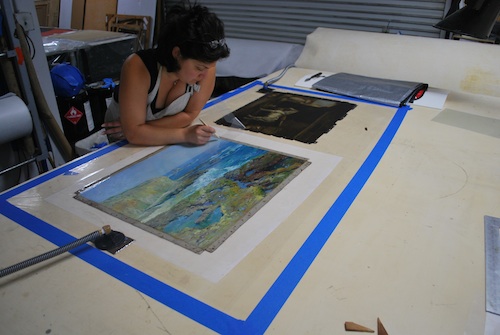
and... doing structural work on two paintings. The closest one needed previous restorations removed and then a new  "lining" to correct and stabilize cracking. The second did not require undoing previous restorations but needed a consolidation and warmth to stabilize flaking.
Oriana Montemurro Working on two paintings
See some of our cool videos on YouTube at our channel "bestartdoc"
Conservation questions? Call Scott Haskins 805 564 3438
Fine appraisal questions? Call Richard Holgate at 805 895 5121
Are you an art collector? Go to www.tipsforartcollectors.org/blacklight-package

Wednesday, July 13, 2011

Watercolor with Mold Has An Interesting Story -


I think this is one of those art conservation stories that’s particularly interesting to art collectors:  I was called one day to look at a framed watercolor by Edouard Vysekal that had mold on it. Turns out that the lady who called was the 84 year old niece of the artist, a well know California artist for whom an exhibition is being organized, right now, at the Pasadena Museum of California Art (PMCA). See the photos, read the story, learn about the exhibition at  http://bit.ly/oC6npi 

Scott M. Haskins

Friday, July 8, 2011

How To Archive Family Photos Cheaply, Easily and Have Fun

Wow! Now I get to walk my talk. We just "inherited" a big box full of my grandfather's family photos. "One more thing in my life to organize?" might be the lament... Oh, c'mon, its not that bad... it can even be cheap, fun and fast to put them into archival storage. See quick video at http://youtu.be/8A_7h4yTskE

Too much to do? It can be quick fun and easy.

Inheriting family photos happens to most everyone sooner or later... it even happens to me, Scott Haskins, author of "How To Save Your Stuff From A Disaster"

Thursday, June 30, 2011

Minerva Teichert's Previously Restored Painting Needs Redoing

This is a detail of a painting my Minerva Teichert, an important Mormon artist at the first half of the 20th century. Its a huge oil on canvas measuring 9' x 8'... and is one of a pair that hang in the LDS Museum of Church History and Art in Salt Lake City. 


More and more the painting was not looking too good, visibly falling apart even though it was restored in the not too distant past: we wondered if it was really clean because it should have been more colorful, and bubbles  were forming where the canvas was detaching from the panel it was glued to. Not until we got it off the wall did we realize that it had been glued to plywood!


So, what's wrong with plywood you might ask? Well, both plywood and Masonite are very acidic materials and cause canvas and paper to deteriorate quickly if they are in contact. In addition to that super non archival product, the choice of a "permanent" glue (any glue you by at the hardware or construction supply store) and you can have yourself a real preservation mess!


As I write this, we are working very carefully to remove the canvas from the plywood in a way that will not stress the paint layers or kink the fabric. As you might guess, our main objective is NOT to get into a mess of flaking or raking paint. Here's a picture of a roll we use to help us handle the artwork as we finesse the canvas off the plywood.

After removal, we'll spend a lot of hours cleaning the adhesive off the back of the canvas that was left behind after its removal. That's a super important needful process in order to have the painting look right when we mount it to a new special panel. More on that later... and maybe we’ll make a short video of the art restoration treatments. Stay in touch.

If you like Minerva's work, like our blog or like knowing about art conservation/restoration and Mormon historical projects, please "Like" this blog post and give a THUMBS UP. Also, please comment! Pass it along to others you know will enjoy knowing the INSIDE SCOOP on Mormon historical items.
See some of our videos on Youtube at “bestartdoc”
Have art conservation questions? Call Scott Haskins 805 564 3438 best_artdoc@yahoo.com
For more info about what's going on in the lab go to www.fineartconservationlab.com
Follow us on Facebook.


Monday, June 20, 2011

Art Conservation of Kent Twitchell's Mural of Biola Jesus - 2nd Video of Consolidation

This short second video shows the treatments that seem to miraculously regenerate the whitened varnish. By also absorbing into those layers an adhesive, the original colors reappear in a startling way.


The work is performed by Scott M. Haskins, art conservator on the mural by Kent Twitchell at Biola University in La Mirada, California. See blog page dedicated to project at http://www.fineartconservationlab.com/twitchell-biola-jesus-mural/

1st video shows tests and examination
3rd video shows Kent's restoration
4th video shows techniques of final varnish

Scott M. Haskins 805 564 3438 best_artdoc@yahoo.com www.fineartconservationlab.com
Kent Twitchell, 310 709 2037

Please pass this link onto others.

Sunday, June 12, 2011

Video: Shows Twitchell Mural "Biola Jesus" evaluated and tested for art restoration

Kent Twitchell's Biola Jesus Mural is evaluated and tested for mural restoration and art conservation http://youtu.be/rOeBj7FdXnA  Please pass along link to others

Saturday, May 14, 2011

Hey, Y'all... I need your help.

Hey y'all. I'm planning to promote an UV Blacklight package for collectors and I have a phone script I need to test. Can I talk to you on the phone? It'll take a few minutes. Call me at 805 570 4140 or email me your phone number at best_artdoc@yahoo.com. I don't need to be your "real life" friend. I'll talk to anyone who wants to chat. It should be a very interesting chat if you like art and collecting. Thanks. TTYS