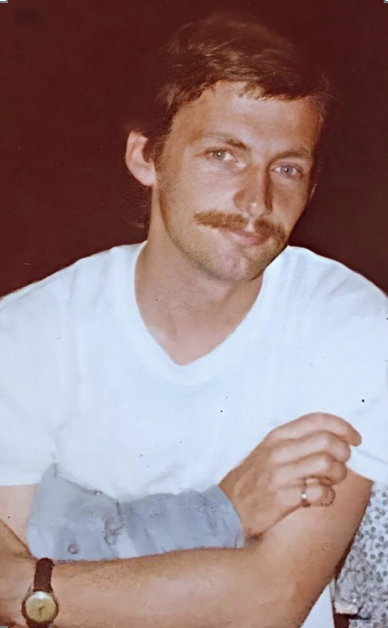
What is even more interesting is that this unlikely connection was made at the beggining of my carreer y first private client was the family estate of the most famous man in the world and it was the beginning of working with people long distance
By Scott M. Haskins
This blog post has been syndicated at ExpertClick.com. What does it mean that this article is “ syndicated”? See details at end of this blog post.
Posted on July 8, 2023 about a look-back at events of 1977-78

As I write this and post it, I am in Florence, Italy looking over a job for the US Consulate/Embassy who are concerned about cracks in affrescoes in the historical building where the Consulate is located, poor quality previous restorations, removing repainting over historical paintings and design details. Its been 45 years since I finished my upper division studies in painting conservation here in Italy and I have been thinking about some of the circumstances that got me started in my profession. Let me tell you about three foundational experiences that proved to be important for my future and that will tweek your interest if you are into art, historic preservation, art restoration, Italy etc… and a good story. I’m often asked how I got started. So, here I am in 1977 (45 years ago)…

I was approaching the end of my three-year master’s degree level, fine art conservation program (1978) at a Lombardy Regional satellite center of the Istituto Centrale di Restauro in Rome. In addition, I considered my efforts to experience “extracurricular work” a supplement to my formal program work, which, justifiably, was not production oriented and was very slow paced.
In an attempt to see a balanced picture of the art conservation profession, I had applied and been hired at a local “hack shop” restoration bottega, where they were specialized in quick, cheap work and low prices. It seemed Sig. Bertoldi liked me but given my newly acquired academic and professional practical skills, I was not as quick to complete tasks as he wanted, and I refused to clean paintings with a mop, figuratively speaking. His techniques and speed at cleaning paintings, especially 19th century art, often resulted in extensive damage to the painting’s original paint layers in the process, and then his shop just re-painted… it was a good education about “the other side of the tracks.”
Soon after the employment with Signor Bertoldi ended, a coworker from the bottega referred a client to me for work to be done on my own. I felt ready to “give it” a try. It seemed my friend from the bottega must have said some kind things about me because my new client, Mr. Montini did not seem uneasy about working with me. I thought it was interesting that, even though he lived outside of town that he would drive an hour on a two-lane country road to come and see me… and he didn’t seem too bothered to do it again to pick up his restored item when I was finished. He was obviously very pleased with my work, and maybe that helped him justify the travel time and effort. He then, enthusiastically, invited me to come to his house and look over some other things that could be restored. So, my first private transaction was a big success.
Now it was my turn to negotiate the two-lane country road, up a valley and through small towns just north of Brescia, Italy.
The Valletrompia today may be one of the areas of Italy with the highest per capita income due to the numerous cottage industries of international renown. It has had an active population consisting of many towns since at least medieval times and was probably in an active transit corridor during Roman times. Within the year, I would be coming up this road again to undertake a project on behalf of my formal art conservation training program. At the top end of the pre-alpine valley is the town Lumezzane, and in the Romanesque-turned-Renaissance parish Church, I was given an affresco to work on as part of my master’s degree final exam.

But a ways before the end of the valley is the small, sleepy, poorly lit, non-descript town of Concesio. It was late in the afternoon before I arrived, and it was suggested that I arrive before it gets dark, or I would never find my way around town (decades before GPS was invented). The detailed directions brought me to a large unlit residential compound, that was the only construction on its side of the street and left little room for a sidewalk along the narrow street with its 3 story wall and the huge front door, all very plain and very old… I was thinking, probably at least 300 years old. Although, big, exclusive, and ancient, it was not at all architecturally or artistically noteworthy. In fact, everything could’ve used a cleaning and some fresh paint.

Mr. Montini, himself, answered the front door with a smile and a handshake, dressed as before, in well used, casual clothing, and welcomed me inside. I walked into the predictably cold interior of the huge, cavernous, dimly lit, poorly heated, rooms. My previously restored item had a place of honor in the huge hallway by the front door. Perhaps that was its downfall as the cleaning lady kept this area, looking better than the rest of the house, and had accidentally knocked it to the floor. Mr. Montini was very nice and made several nice comments and noted my work as we walked by.
As soon as I entered the house, I already had a broken neck noting everywhere, practically, that the walls were full of framed paintings and textiles. The artwork was displayed, hung gallery style, from the baseboard to the crown molding on absolutely every wall of the house and the ceilings had affrescoes. The paintings were hung only inches apart and covered completely the 10-15 foot walls of the hallways, large rooms and every room and passageway that I could see as we passed. They even covered the walls of the bathroom I visited. I’m not exaggerating when I say that there were literally thousands of paintings small to very large (today, the residence has been made into a memorial and museum and appears MUCH different than when I visited).
Mr. Montini of course, was not trying to impress me, nor satisfy my kid in the candy store look on my face. He was nice and conversational, but he did not seem to know a lot about the artwork or furnishings and made no effort to turn on special lights to show better the art as collectors like to do when they have visitors.
After we got past “the pleasantries” and he got to know me a little better, he divulged that I was sitting in the family estate of the ancient and powerful Montini family and the childhood home of Giovanni Battista Enrico Antonio Maria Montini,
the present/current day most famous man in the world… Pope Saint Paul VI, presently, at that time, in authority in the Vatican.
The Mr. Montini in front of me, was a cousin, and had been appointed by the family as the caretaker of the estate. He told me all this matter of factually with no flair or need of recognition. In fact, I had the sense that the whole thing bored him terribly!
It was a nice visit, and when it was over, I left the house with a darkly painted 18th century oval portrait of an ancestor count or duke or something or other. Thinking back on that project portrait he gave me, it was probably a test, once again, to see the quality of my work. While the work on the painting was fairly straightforward visually, oval portraits can sometimes be tricky when doing structural work.

Apparently, I passed my test with flying colors and he was enthusiastic about the results of the painting conservation treatments when I delivered his painting on my second visit. We sat and had cookies and hot chocolate, while I was encouraged to tell my story, and he enjoyed inquiring about my opinions about how to resolve the problems of the world. But we did not talk about art!
I guess by this time I was fully vetted and my work appeared to him to be of high enough quality that he enjoyed the expression on my face when he consigned to me a 4’ x 2’ painting on canvas of a male clothed figure painted in the mid 1500’s by Paolo Veronese (I think he told me that someone in the family bought it directly from the artist! It looks stylistically as if it came from the planning of San Sebastiano in Venice)

Wow. I thought it strange, though, that despite the fame and value of the painting he gave to me to work on, he never checked in on me, or asked to visit me during the couple of months it took me to return the work to him. Also, interesting to me was the trust that he gave my professional opinion about what needed to be done and without question, agreed to everything I suggested.
And that was the beginning of working autonomously in my new profession of art conservation. It was 100% a positive experience and a good start.
If this is your first time on this blog, poke around to see other interesting articles, videos, testimonials. There are pull down menus under the rotating photos in the header of the website. Please leave this article a "thumbs up" at the top of the page and a comment at the bottom of the page. Thanks!
Want to know more about Fine Art Conservation Laboratories today?
Our firm, Fine Art Conservation Laboratories (FACL, Inc.) is called in often to clean, preserve, restore and even remove and reinstall murals, treat water damage on paintings, stop and preserve paintings with flaking, repair rips, stop cracking and much more
For general mural conservation capabilities videos: https://www.youtube.com/watch?v=ld4l6EG8T-I&index=13&list=PLE1FF71CC598A8E79
For our mural capability statement: http://www.fineartconservationlab.com/mural/
For our mural consultation statement: http://www.fineartconservationlab.com/consultations/
Our mural conservation videos on YouTube at https://www.youtube.com/playlist?list=PLE1FF71CC598A8E79
If you have questions, call:
Scott M. Haskins 805 570 4140 faclartdoc@gmail.com
Or
Virginia Panizzon, Veteran Art Conservator 805 564 3438 office
p.s. If you would like to know more about what you can do to protect and preserve your original family history items, collectibles and memorabilia click on this link for a free copy of Scott M. Haskins book Save Your Stuff – Collection Care Tips, 210 pages with 35 embedded how-to videos.
p.s.s. CLICK HERE for our YouTube channel - Subscribe! See quick video on Discovering Hidden Signatures on Paintings! http://www.youtube.com/watch?v=kxOqa-Aa9Nk
This blog post has been syndicated at ExpertClick.com. What does it mean that this article is “ syndicated”?
It's a bit of a coup to get an article syndicated, and its certainly prestigious, as additional "proof" that the info and the author are considered far and wide authoritative and an expert in the field. So, enjoy and trust our content!! This article was syndicated for USA national redistribution.
When something is published, usually by a news source, and is made available through different venues for redistribution then it is said to be syndicated. Publications that are syndicated are usually considered of value as being from an expert, educational, newsworthy or valuable for wide popular interest. See syndication page at the renowned publicity site: https://www.expertclick.com
This website's syndication included:
1) Included in the ExpertClick Press Room as a ‘press release.’ (different than a ‘news release’)
2) Included in the ‘Speaker Bureau Platform Page.’
3) Shown on the front page of ExpertClick, in rotation with other most recent posts.
4) Shown in the ‘News Release Results page.’
5) Included on optimized for searches on all my topics of expertise.
6) Shown via RSS linked from the Press Room. (A specific way news is actively distributed within the industry)
7) Shown in the full RSS feed from ExpertClick. (Another, different specific way news is actively distributed within the industry)
8) Syndicated to LexisNexis.com As of 2006, the company had the world's largest electronic database for legal and public-records related information, distributor of academic content and expert opinion.
This article has been syndicated at https://www.expertclick.com