Saturday, September 10, 2011

Kent Twitchell Finishes Restoration of The Biola Jesus Mural


I'm in Los Angeles (La Mirada) today putting the final varnish on Kent Twitchell's Biola Jesus mural. Kent, the original artist of the mural done in 1990, is in charge of the restoration. But he has brought me on as part of the effort to consult with him on conservation efforts/needs. Today, I'll also be shooting the final clips for the video I've made of the project. Stay tuned!

If you haven't seen the two previous short videos yet, of the analysis before the work and the video on consolidation and conservation efforts, go to www.fineartconservationlab.com/twitchell-biola-jesus-mural

Friday, September 9, 2011

Dutch Old Master Restored - Frame Restoration


Just finished, in the lab, a beautiful Dutch Old Master oil on panel for a collector in Las Vegas. We took of a lot of retouching off during the cleaning which was not needed and cleaned the old discolored varnish off the reveal the glow of the original. This was really treat to see completed.

The frame is not original, although it is beautiful. While the painting was being worked on, we had the frame restored too. It was stripped of ugly gold paint and was re-leafed with 23 k. gold and antiqued to a period finish, similar to its original finish. Its from the middle of the 1800's. The painting is from a hundred years earlier. www.fineartconservationlab.com

Thursday, September 8, 2011

This LeConte Stewart Oil Painting Required a Double Cleaning

When I cleaned this landscape by LeConte Stewart years ago, I didn’t really know the artist’s work. I’ve worked on a few more paintings by this artist over the years usually through William Karges Fine Art or George Stern Fine Arts. But then, this week, I was meeting with the LDS Museum of Church History and Art in Salt Lake City, UT and they had up a wonderful exhibition of LOTS of Stewart’s paintings.

Double cleaning of an oil painting
Sometimes different layers of dirt come off with different solvents and require a double... or even a triple cleaning.


Over the years I have used this photo to show of the stages of cleaning a rural Utah landscape by LeConte Stewartas an example of how, sometimes, a painting can require several cleaning stages to get it completely clean duringart conservation treatments. This is really quite a common situation where the solvent that takes off the top layer of crud, doesn’t touch the underlying discolored varnish layer… and sometimes it can be more than two layers! When doing the cleaning tests in order to estimate a budget, this multiple cleaning is usually met with conflicted feelings by the owner: its thrilling to see how big a difference there will be but… the double or triple cleaning process is more expensive. Its part of the price to get the job done right. I can’t tell you how often we have people bring paintings in the art conservation lab that have JUST BEEN CLEANED by someone else… they failed to either know what to do or they didn’t see the additional layer of discoloration left behind after the first cleaning… and the painting still need to be cleaned further.


Actually, two Salt Lake Museums are exhibiting the works of this Utah painter, which marks the first ever joint collaboration between the LDS Church History Museum and the University of Utah Museum of Fine Arts. I saw the exhibition at the LDS Museum of Church History. See video and KSL article at http://www.ksl.com/?nid=148&sid=16473783

I was really wowed. His artwork, large and small, was of a very nice quality. He was very poetic in interpreting boring rural Utah landscapes into beautiful colors, contrasts, composition and emotions that I would have never thought possible… and was drawn to! His perspectives, draftsmanship and confident execution are consistent throughout the exhibition. It was a real pleasure and inspiration.

If you have the chance to get by the museum for the show, set the time aside. I wish the museum would have published a catalog. But they did produce a DVD that is available in the gift shop.

Do you have art conservation questions? Call 805 564 3438
Art appraisal questions? Call Richard at 805 895 5121
For more important tips for art collectors, go to www.tipsforartcollectors.org/uv-blacklight

Monday, August 22, 2011

Broken Hanging Wire Causes RIpped Painting and $4,300.00 Worth of Damage


Look at the back of the painting's rip
The reverse side of the painting with the rip, caused by the hanging wire breaking

The Laguna Arts Festival holds a lecture series (http://bit.ly/pVVE6C) and I was their visiting expert last week.  I spoke about general things to think about when protecting and saving collectibles, artwork etc. Well, yesterday, someone’s disaster walked through my front door. A valuable vintage painting’s wire broke and the oil painting on canvas hit the edge of a table and here’s what you get… a 6 inch x 18 inch “L” shapped rip and flaking paint. See the informative story with tips, link and videos at http://saveyourstuffblog.com/paintings/how-to-hang-a-painting-and-do-it-right/
  •  You do the math; be a good curator of your collection or mishaps like the one in the photo above are $4,300.00 to fix perfect.
Questions” Call Scott at 805 564 3438
Art appraisal questions? Call Richard at 805 895 5121
Also see http://www.fineartconservationlab.com
Did you find this article helpful? Click on the THUMBS UP!
Please leave a comment.

Broken Hanging Wire Causes RIpped Painting and $4,300.00 Worth of Damage


Look at the back of the painting's rip
The reverse side of the painting with the rip, caused by the hanging wire breaking

The Laguna Arts Festival holds a lecture series (http://bit.ly/pVVE6C) and I was their visiting expert last week.  I spoke about general things to think about when protecting and saving collectibles, artwork etc. Well, yesterday, someone’s disaster walked through my front door. A valuable vintage painting’s wire broke and the oil painting on canvas hit the edge of a table and here’s what you get… a 6 inch x 18 inch “L” shapped rip and flaking paint. See the informative story with tips, link and videos at
  •  You do the math; be a good curator of your collection or mishaps like the one in the photo above are $4,300.00 to fix perfect.
Questions” Call Scott at 805 564 3438
Art appraisal questions? Call Richard at 805 895 5121
Also see http://www.fineartconservationlab.com
Did you find this article helpful? Click on the THUMBS UP!
Please leave a comment.

Thursday, August 18, 2011

Patching a ripped easel painting - not a good idea.


I'm often asked about whether patching a ripped or punctured oil or acrylic painting is a good option. Here's is a quick video to show you the side affects: http://bit.ly/r6gNh6

Wednesday, August 17, 2011

Famous Mormon Mural by LA Ramsey Found and Saved


This painting of the Angel Moroni delivering of the plates of the Book of Mormon to Joseph Smith by Lewis A. Ramsey is one of the best know paintings in the LDS Church. Unknown and lost for decades,  I was part of the rediscovery of this “long lost masterpiece." Go to the following link to see this video about the incredible story how it was saved from demolition, lost, rediscovered (smelly!), conserved and restored.
More interesting blog posts to come! Stay in touch. Sign up for updates.
Art conservation questions: Call Scott Haskins at 805 564 3438
Art appraisal questions? Call Richard at 805 895 5121
Also, check out www.fineartconservationlab.com

Wednesday, July 27, 2011

Scratching a painting to clean it? Restoring an oil painting.

What would you say if I told you we had to scratch a painting to clean it? Here's an interesting article about a very hard varnish on kind of a weird cool painting.

Click here: http://www.fineartconservationlab.com/projects/in-lab/antique-oil-painting-of-old-time-circus-requires-tricks-for-cleaning/

Questions about art conservation and restoration? Call Scott at 805 564 3438
Fine art appraisal Questions? Call Richard at 805 895 5121

Tuesday, July 26, 2011

How much does it cost to clean a painting? See video


I'm asked this question all the time over the phone. Sight unseen, there is supposed to be, I assume, a standard, per sq. inch price! Sorry... it's much more complicated than that.

Here's an interesting video of a cleaning we did of two important pictures that were by the same artist, same size but very different to clean. Take a look: http://bit.ly/qGRQsW 

Cleaning a painting by Armin Hansen from the Monterey Museum of Art
Art conservation/restoration questions? Call Scott Haskins at 805 564 3438
Art appraisal questions? Call Richard at 805 895 5121
See our YouTube Channel at "bestartdoc"

Leave a comment!

Tuesday, July 19, 2011

Discovering Secrets of Revealing Inpainting (Retouchings) on Art and Antiques with a UV Black light - TIPS!

Here’s a very useful tip for art collectors who use a black light. Using a blacklight is part of your investing survival techniques and technology! Everyone should use a black light when inspecting and evaluating art and antiques.
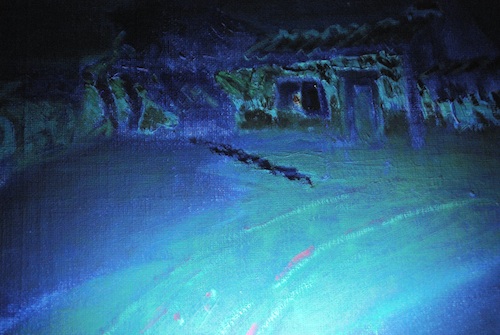
This painting is leaving the lab today, after we repaired a rip in the center of the painting. It poses an interesting uv light inspection problem though… its a night scene.
Retouching shoing up with a blacklight
New inpainting/retouchings show up bright with a UV black light


As you can see in the photo, even though its been cleaned, it still glows green. That’s because night scenes have lots of varnish usually in the paint. So, if you see a night scene glowing green when you shine your black light on it, it MAY not be because of old varnish!
One good thing about this though; the green glow makes it easier to pick out inpainting or retouchings. And this photo is a great example:
Note the purple nature of the composition of the painting. How do you tell the difference between a purple glowing original detail and the same purpleness of a retouching? Look to see if the purple color pattern follows the painting’s compositional details. If it cuts through details of the painting, its surely a repair… as in this painting.
Also note the careful exact way this inpainting was done. It was done with a small brush. That’s a hint that the conservation work/restoration work was conscientiously done.
Was this article helpful or interesting? Leave a comment please.
For more info on black lights, tips and fun videos, go to www.tipsforartcollectors.org/blacklight-package
Conservation questions? Call Scott at 805 564 3438
Appraisal questions? Call Richard at 805 895 5121
See YouTube Channel “bestartdoc”